Bridget Jones–Mark Darcy relationship
Bridget Jones: Mad About the BoyThe relationship between Bridget Jones and Mark Darcy is presented as a marriage whose intimacy survives its abrupt ending. Their history reaches back to Bridget’s childhood, and their trust gives her a sense of safety from which she can meet the world. When Mark dies in Darfur, that shared life becomes both the source of her grief and the inheritance—emotional, parental, and practical—that enables her and their children to go on.
A history of intimacy and trust
Bridget’s memories make clear that Mark was not simply a husband she had loved for a few years. She had known him since she was a child running unclothed around his parents’ lawn, and she recalls that the uncertainty of dating him before their marriage was different from the loneliness she experiences after his death: even then, she knew him unusually well. The long acquaintance gives their adult relationship a sense of continuity, as though marriage grew out of a familiarity already established in childhood.
One of Bridget’s most private recollections is of talking to Mark while he slept. She would ask whether he was lovely and whether his mother loved him. In her account, his sleeping face looked sad and ashamed, and he seemed to resist acknowledging his mother’s love. Bridget connects this vulnerability to his having been sent away to boarding school at seven. The contrast is central to her understanding of him: the powerful human-rights lawyer could also seem to her like a hurt child, and her closeness included tenderness toward that hidden pain.
When Bridget asked in these half-asleep conversations whether she loved him, she remembers Mark smiling, nodding, and drawing her under his arm. Their physical affection and emotional confidence belong together in her memory. She describes their knowledge of one another as complete and the marriage as a safe base from which she could explore a frightening world. With Mark beside her, that world resembled an ocean approached from the protection of a small submarine; after his death, safety itself seemed to have disappeared.
Marriage interrupted by death
Mark’s death in 2008 transformed a living partnership into an absence around which Bridget had to organize everyday life. A newspaper clipping records that he was killed in the Darfur region of Sudan when the armoured vehicle carrying him struck a landmine. Anton Daviniere, a Swiss representative of the UN Human Rights Council, was also killed. The report describes Mark as an internationally recognized authority on cross-border litigation and conflict resolution, and notes that he had helped secure the release of British aid workers Ian Thompson and Steven Young after seven months as hostages. His public work and his private role as husband and father meet in the same stark account: he leaves Bridget, their two-year-old son Billy Darcy, and their three-month-old daughter Mabel Darcy.
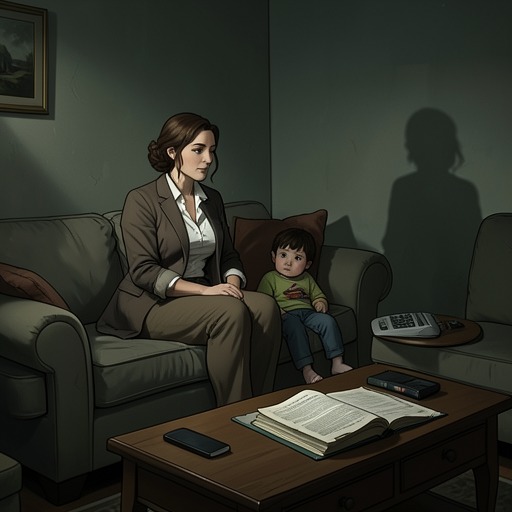
Bridget remembers the first shock through fragments: Billy running through the house saying he had lost his father; Jeremy and Magda arriving with a policeman; and Mark’s face appearing on television beneath the dates 1956–2008. Her memories of the surrounding period blur, but the bodily pattern of bereavement remains precise. She would wake early, briefly believing life was unchanged, then remember Mark and feel immobilized by pain. Within half an hour the children would wake, and she had to return to the tasks of motherhood, sometimes waiting until help arrived before she could cry alone in the bathroom.
The marriage continued to shape the practical conditions of Bridget’s survival. Mark had arranged the financial details and insurance policies, and his lawyer friends helped sort out his affairs. Bridget and the children left the memory-filled large house in Holland Park for a smaller house in Chalk Farm. School fees, housing, bills, and income had been provided for, so she did not have to find work immediately. The arrangements could not replace Mark, but they made it possible for Bridget to keep caring for Billy and Mabel while she experienced herself as devastated and emptied out.
Grief, memory, and the children
Bridget’s mourning includes a persistent wish to share ordinary life with Mark again. In a letter written to him, she says she needs his comfort, advice, reassurance, and physical closeness. She misses not only his counsel but also the small acts of intimacy that had belonged to their life together. Her letter moves between love, sexual longing, regret, and guilt about dating; she apologizes for being distressed by anything other than his absence, even as she recognizes that she must continue living. The struggle is not to replace the marriage but to inhabit a life that no longer allows its familiar exchanges.
The children keep the relationship present in daily conversation and objects. When Billy and Mabel tell Bridget they have made Father’s Day cards, she pulls over and turns off the car before looking at them. At home she brings out photographs: Billy in a small suit matching Mark’s, standing in the same pose with one hand in his trouser pocket, and Mark holding newborn Mabel in her onesie. Bridget talks with the children about their father and tells them she believes he knows what they are doing and still loves them. They post the cards; Mabel addresses hers to her father in Heaven and Space. The scene makes remembrance an activity the children can share, rather than a subject confined to Bridget’s private grief.
Their questions and losses remain distinct. Mabel was too young to know Mark when he died, while Billy had memories of losing him and later wishes his family could be normal like Rebecca’s. Bridget’s assurance that their father continues to love them cannot give them a father physically present in their lives. It does, however, preserve Mark as part of their family story, supported by photographs, names, and the repeated act of speaking about him.
The marriage’s continuing presence
The novel repeatedly places Bridget’s later relationships beside the life she had with Mark without treating them as equivalent. When she begins seeing Roxster, the affair offers a separate adult life and the pleasure of being cared for, but Bridget’s thoughts continue to return to Mark and to the children’s experience of growing up without him. At one full moon, she imagines how Mark would have handled the flood of school-concert emails: he would have cleared them quickly and replied that he would bring hummus and black bin liners. The imagined domestic competence is as significant as grand declarations; it is the ordinary partnership she misses.
The Christmas memories likewise arrange Bridget’s life in successive periods: childhood with her parents, years of being single, the Christmas she spent texting Roxster, and the first Nativity play after Mark’s death. That last Christmas seemed cruel simply because it continued to happen. The sequence measures the marriage by its place in a larger family history: Mark’s absence does not erase the earlier Christmases spent with him and Billy, but it changes the meaning of every celebration that follows.
At the novel’s close, Bridget believes Mark would be glad that she and the children are no longer alone and that she has found a partner in Mr Wallaker. The new household includes Mr Wallaker’s sons, Matt and Fred, as well as Billy and Mabel; Mabel now has a father present in this world, while Billy has older boys to play with. Bridget describes feeling safe, cared for, and no longer lonely. The ending does not undo Mark’s death or suggest that the first marriage has been replaced without remainder. Instead, Mark’s imagined approval lets Bridget accept a future in which love and family continue, while her memories of him remain part of the home she has made.